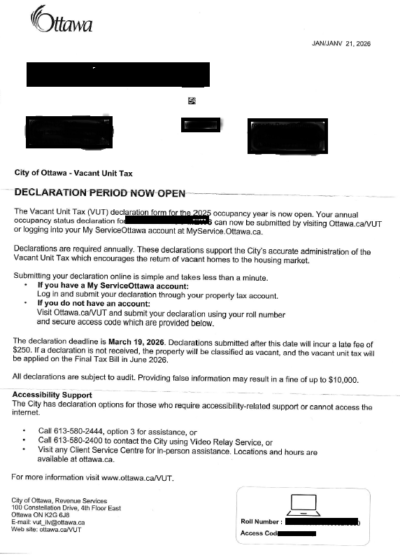

If you own residential property in Ottawa, there is one administrative task you cannot afford to overlook every winter. From January to March each year, the City of Ottawa opens the declaration period for the Vacant Unit Tax (VUT) for the previous occupancy year. The declaration period for the Vacant Unit Tax (VUT) for the 2025 occupancy year closes on April 30, 2026. To file without penalty, you must submit your declaration by April 30, 2026.
Whether you are a seasoned real estate investor, a landlord, or simply a homeowner living in your principal residence, you must submit a declaration.
At CoLex Legal, we know that administrative oversights can lead to unnecessary financial liability. Here is your legal briefing on what the VUT is, the critical 2026 deadlines, and the new penalties for repeat vacancies.
The "Must-Know" Rule: Everyone Declares
A common misconception is that this tax only applies to investors with empty portfolios. This is false. Every residential property owner on the Property Tax Roll—including those owning detached homes, condos, and principal residences—must file a declaration annually.
The Golden Rule: Even if you have lived in your home for 20 years and have never left it vacant, you are still required to declare its status to the City.
Critical Dates for 2026
Mark these dates in your calendar to avoid automatic penalties.
- Declaration Deadline: March 19, 2026
- Late Filing Deadline: April 30, 2026
- Late Fee: Declarations filed between March 20 and April 30 are subject to a $250 late fee.
If you fail to declare by April 30, your property will be deemed vacant by default, triggering the tax liability regardless of actual occupancy.
New for 2026: The Graduated Tax Rate
This year introduces a significant change that affects properties left vacant for multiple years. The City has introduced a graduated tax rate to further discourage long-term vacancies.
- Standard Rate: 1% of the property’s assessed value for the first year of vacancy.
- The Increase: Starting with the 2025 taxation year, the rate increases by 1% for each consecutive year the property remains vacant, up to a maximum of 5%.
Example: If your investment property was declared vacant last year and remains vacant this year, your tax liability may increase from 1% to 2% of the Municipal Property Assessment Corporation (MPAC) value.
Exemptions: When "Vacant" Doesn't Mean "Taxed"
Under the by-law, a property is considered vacant if it was unoccupied for more than 184 days in the previous calendar year (2025). However, specific legal exemptions apply if declared correctly:
- Sale of Property: Ownership was transferred during the year.
- Renovations: Major construction or redevelopment prevented occupancy (active building permits are generally required as proof).
- Life Events: The owner passed away or was hospitalized/placed in long-term care.
- Court Orders: A court order prohibited occupancy of the property.
Legal Note: You must declare the exemption and provide supporting documentation (e.g., death certificates, building permits, or sale agreements) if audited.
How to File Your Vacant Unit Tax Declaration
The process is digital and typically takes less than five minutes.
- Visit the City of Ottawa VUT Portal to submit the Declaration Form or log in to My ServiceOttawa.
- Locate your Roll Number and Access Code. These can be found on your most recent property tax bill or the VUT notice sent to you by mail/email.
- Confirm the occupancy status (e.g., Principal Residence, Tenanted, or Vacant with Exemption).
The Consequence of Inaction
Ignoring this notice is costly. If a property assessed at $750,000 is deemed vacant by default, the owner could face a tax bill of $7,500 (at the 1% rate) plus the late fee. While audits and appeals are possible, they are time-consuming and subject to strict timelines.
Frequently Asked Questions (FAQ)
No. As long as the property is your principal residence, you are not subject to the tax. However, you are still legally required to file the annual declaration confirming it is your primary home.
Responsibilities vary based on the closing date. If you purchased the home between January 1 and April 30, 2026, the seller is typically responsible for declaring the 2025 status. However, as the new owner, you should ensure this was completed to avoid a surprise tax bill on your first final tax installment.
Yes, but it is specific. An exemption exists for "Major Renovations," but the City typically requires that building permits were issued and the work was carried out "diligently and without unreasonable delay." You will need to provide your permit numbers during the declaration.
You can file a Notice of Complaint (the first stage of the appeal process). The deadline for this is typically September 15, 2026. If you miss even that deadline, a "Late Appeal" is possible until December 31 of the following year, though it carries a non-refundable $500 administrative fee.
No. The VUT currently only applies to properties in the residential tax class with six or fewer units. Commercial and industrial properties are excluded.
How CoLex Legal Can Help
Real estate regulations in Ottawa are evolving. If you are facing a dispute regarding a VUT assessment, a rejected exemption, or complications involving a property transaction where tax liabilities are unclear, our team is here to assist. Email info@colexlegal.ca for legal advice and assistance.
Don’t let a paperwork error become a tax liability. Check your mail for your Roll Number and file your declaration before March 19.
Disclaimer: This post provides general information and does not constitute legal advice. For specific legal questions regarding property tax or real estate law, please contact our office.